Ship Retrofit Inspection: How AI and Mixed Reality Help Verify As-Built Conditions

Retrofitting an existing vessel can introduce engineering challenges that are difficult to resolve from original drawings alone. Years of modifications, undocumented repairs, equipment replacements, and structural changes can leave shipyards working with engineering records that no longer fully represent the vessel.
For shipowners, naval architects, and shipyard engineering teams, these discrepancies matter when planning propulsion upgrades, installing new equipment, modifying piping systems, or modernizing vessels for changing operational requirements.
AI-assisted inspection, 3D reality capture, and mixed reality (MR) can help teams compare existing vessel conditions with engineering models before committing to fabrication and installation. The objective is to identify discrepancies earlier, improve engineering coordination, and make retrofit decisions using better information about the vessel as it exists today.
As the maritime industry explores digital engineering at SNAME Maritime Convention 2026, as-built verification offers a practical application of digital twins beyond new-build design reviews.
Why ship retrofits need accurate as-built information
Original CAD models and engineering drawings provide an essential design reference. However, the physical vessel may have changed since those documents were created. Common challenges include:
- **Undocumented modifications:** Previous repairs or equipment replacements may not appear in the original engineering model.
- **Restricted access:** Machinery spaces, service compartments, and congested piping areas can make measurements difficult.
- **Spatial conflicts:** New equipment may compete for space with existing structures, cables, pipes, or machinery.
- **Maintenance constraints:** A component may fit geometrically but leave insufficient access for operation, inspection, or future replacement.
- **Fragmented inspection records:** Photographs, measurements, drawings, and maintenance records may be stored separately, complicating engineering reviews.
These issues can affect retrofit planning, prefabrication, installation sequencing, and quality assurance. The solution is not simply to create another 3D model. Shipyards need a reliable way to connect the vessel's physical condition with the engineering information used to plan modifications.
How AI and 3D reality capture support ship retrofit inspection
Reality capture provides a digital representation of existing conditions. Depending on the environment and required accuracy, teams can use terrestrial laser scanning, handheld scanners, photogrammetry, or other suitable capture methods.
The resulting point cloud or 3D representation can then be compared with available engineering information.
1. Capture the vessel's existing condition
Scanning can document the geometry of accessible structures, machinery spaces, piping, and other relevant components. The capture plan should account for restricted spaces, reflective surfaces, occlusions, movement, and areas that cannot be scanned directly. These factors influence data quality and determine whether supplementary measurements or inspections are necessary.
The result is a spatial reference that can help engineering teams understand actual site conditions rather than relying exclusively on historical drawings.
2. Process and interpret captured data
Raw scans can contain unwanted objects, incomplete surfaces, and measurement noise. Processing helps prepare the data for engineering review.
AI may support selected tasks such as identifying geometric patterns, classifying objects, or assisting with point-cloud processing. However, automated recognition of pipes, flanges, valves, and structural members depends on the software, data quality, and complexity of the environment. It should not be assumed that every scanned component can be converted automatically into an accurate, editable CAD object.
Where detailed engineering models are required, automated processing may need to be supplemented by manual modelling, dimensional checks, and engineering verification.
3. Compare as-built conditions with engineering models
Once captured data is aligned with the relevant design reference, engineers can examine discrepancies between the existing vessel and the proposed retrofit.
For example, a proposed equipment installation may conflict with an existing pipe run or require more clearance than the available space allows.
A scan-to-model comparison can help identify these differences for investigation before fabrication or installation proceeds. The significance of each discrepancy must be assessed against the project's tolerances, design requirements, and applicable engineering procedures.
4. Review proposed modifications in mixed reality
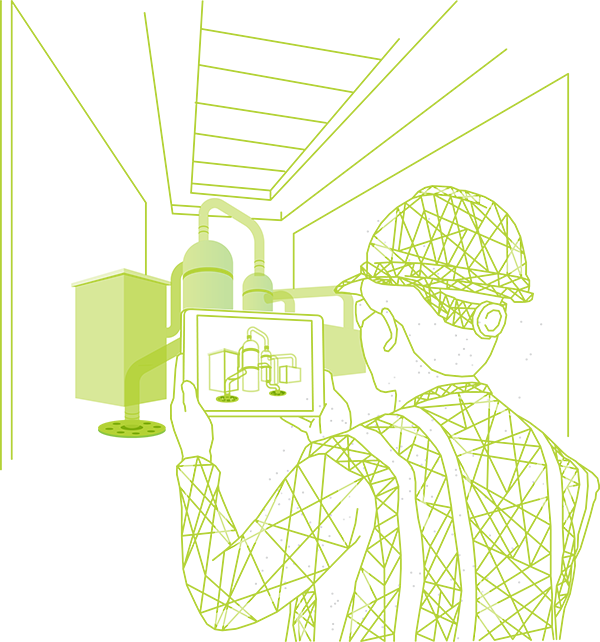
Mixed reality can bring engineering models into the physical environment, allowing teams to examine proposed equipment or modifications in relation to existing structures. For a retrofit project, this can support reviews of:
- Equipment placement and spatial clearances.
- Piping routes and interfaces with existing systems.
- Access to valves, instruments, and service points.
- Maintenance and replacement clearances.
- Installation sequence and coordination between trades.
The accuracy of the overlay depends on model alignment, tracking, calibration, and the reference data available. MR visualization is a review aid, not a substitute for dimensional verification, formal clash analysis, or engineering approval.
Traditional retrofit verification versus a connected digital workflow
| **Project activity** | **Conventional approach** | **Reality capture, AI, and MR-supported approach** |
|---|---|---|
| Existing-condition assessment | Drawings, site visits, photographs, and manual measurements | Spatial capture supplemented by verified measurements and existing records |
| Engineering reference | Original drawings and separately maintained models | Captured conditions reviewed alongside available engineering models |
| Discrepancy identification | Differences discovered during reviews or installation | Scan-to-model comparison helps flag differences for investigation |
| Retrofit design review | Screen-based model reviews and physical site checks | Immersive reviews of proposed modifications in spatial context |
| Installation planning | Coordination using drawings, measurements, and site communication | Shared spatial references can support coordination and installation planning |
| Quality assurance | Inspection records maintained through project procedures | Digital evidence can be linked to findings and review outcomes where systems support it |
These methods are complementary. Reality capture does not automatically produce a complete, verified digital twin, and immersive visualization does not guarantee that every installation conflict will be identified.
Where shipowners and shipyards can apply this approach
Propulsion and machinery upgrades
Replacing or upgrading propulsion equipment can affect foundations, shaft interfaces, auxiliary systems, piping, and access requirements. Comparing captured conditions with proposed engineering models can help teams investigate spatial conflicts and interface discrepancies before equipment fabrication or installation.
Environmental compliance retrofits
Projects involving exhaust gas cleaning systems, ballast water treatment, or alternative-fuel infrastructure can require substantial changes to existing vessel arrangements. As-built verification can help assess available space, routing options, equipment access, and interfaces with existing systems. Final decisions still require the relevant naval architecture, structural, stability, safety, and regulatory assessments.
Repair and structural modification
Repairs and structural changes may introduce differences between the vessel's current condition and historical design information.
Reality capture can provide supplementary geometric evidence for engineering assessment. It does not, by itself, establish structural integrity or replace thickness measurements, non-destructive testing, or other required inspections.
What should shipyards evaluate before adopting AI and MR inspection?
A successful deployment starts with the engineering problem, not the technology.
- **Data quality and accuracy:** Determine the required measurement tolerance, capture coverage, and verification method for each task.
- **CAD and point-cloud compatibility:** Confirm that the workflow can handle the vessel's engineering formats, scan data, coordinate systems, and model complexity.
- **Engineering traceability:** Establish how discrepancies, supporting evidence, verification outcomes, and approved changes will be recorded.
- **Workflow integration:** Identify how inspection results will reach design, production, quality assurance, and project management teams.
- **Deployment constraints:** Evaluate onboard connectivity, data security, equipment suitability, and whether the workflow can operate within the shipyard's working conditions.
- **Measurable project value:** Establish a baseline for remeasurement, design revisions, installation conflicts, review time, and rework. Track changes against comparable project activities rather than assuming a predetermined reduction.
How Exxar supports shipbuilding inspection and retrofit workflows
Exxar's shipbuilding solutions support immersive vessel design reviews and mixed reality inspections using engineering models and digital twin workflows.
For retrofit and modernization projects, the relevant application is comparing existing conditions with approved CAD references, reviewing equipment and system interfaces, and helping teams understand discrepancies in their physical context.
The workflow can complement conventional engineering checks by bringing spatial information into inspection and design coordination. Suitability depends on the available models, captured data, inspection requirements, and site conditions. Explore Exxar's AI visual inspection capabilities to understand how AI-assisted inspection can fit into a broader engineering workflow.
Moving from historical drawings to verified vessel conditions
Ship retrofit projects depend on the relationship between what engineering records show and what teams find onboard. When those two views differ, the discrepancy needs to be identified, assessed, and resolved before it affects downstream work.
“Reality capture provides evidence of existing conditions. AI can assist with selected data-processing and identification tasks. Mixed reality can help engineers review proposed modifications in their physical context.”
Together, these technologies offer shipowners and shipyards a practical way to strengthen as-built verification and improve coordination during vessel modernization, while keeping engineering validation and approved inspection procedures at the centre of the process. For maritime engineering teams evaluating digital approaches to retrofit planning, the priority is to identify where better spatial information can resolve a specific project risk, then validate the workflow against real vessel conditions.
Meet with Exxar at SNAME Maritime Convention 2026