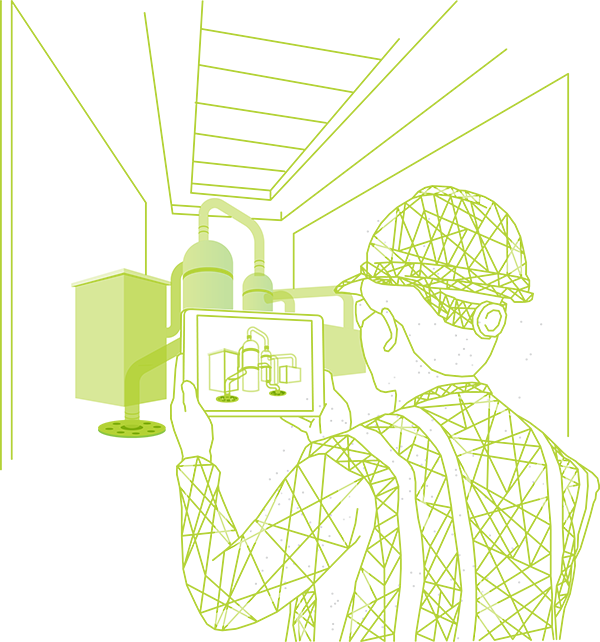
Reduce Engineering Change Orders with a Digital Twin: How 1:1 XR Design Reviews Help UK Manufacturers Prevent Rework

Key takeaways
- Engineering change orders (ECOs) can trigger additional design work, procurement changes, installation rework and disruption to planned maintenance or shutdown activities.
- A digital twin combined with immersive design review helps engineering teams assess proposed modifications in the context of an existing or planned asset.
- A 1:1 XR design review makes spatial relationships, access restrictions, maintenance clearances and potential installation conflicts easier to assess collaboratively.
- XR complements CAD analysis, engineering calculations and formal design verification. It does not replace them.
- The value depends on model accuracy, revision control, stakeholder participation and how effectively review findings are resolved before site work.
Why do engineering change orders create problems for UK manufacturers?
Engineering change orders are a normal part of industrial engineering. They document approved changes to designs, specifications, components or processes. The challenge is not eliminating every change. It is identifying avoidable problems before they affect procurement, fabrication, installation or operations.
For UK manufacturers, process plants and asset-intensive facilities, an engineering change can affect several connected activities.
A modification to a pipe route, for example, may influence nearby equipment access, structural supports, cable trays, insulation requirements and maintenance procedures. A change that appears straightforward in an individual drawing can have wider implications when assessed against the complete installation. Late discovery can lead to:
- Engineering rework: Designers revise models, drawings, specifications or associated documentation.
- Procurement disruption: Ordered components may require modification, replacement or additional approval.
- Installation delays: Site teams encounter spatial constraints or interfaces that were not adequately assessed.
- Maintenance restrictions: New equipment arrangements can make inspection, isolation or component replacement more difficult.
- Shutdown pressure: Changes discovered during a planned outage can compete with tightly scheduled installation and commissioning activities.
Not every engineering change results from a design review failure. Changes can arise from new requirements, supplier substitutions, updated regulations, unforeseen site conditions or operational decisions.
The practical objective is therefore to reduce avoidable engineering changes and identify their consequences earlier, when teams have more options to resolve them.
How can a digital twin help reduce engineering change orders?
A digital twin provides a digital representation of an asset, system or process for a defined purpose. In engineering design reviews, a suitably detailed model can help teams evaluate proposed modifications against surrounding equipment, structures and interfaces.
The UK Government's National Digital Twin Programme provides context for the UK's wider work on connected digital representations and information sharing. It is not evidence that digital twins automatically reduce engineering change orders. Outcomes depend on the information available and how teams use it.
For a plant modification, an engineering team may bring together relevant CAD models, plant layouts and proposed design changes to examine the arrangement before installation. This can help teams investigate three important questions.
1. Does the proposed design fit the existing asset?
A modification may fit its immediate design envelope but conflict with adjacent pipework, structural elements, equipment or services.
Reviewing the proposed arrangement in its wider context helps engineers assess these relationships. Existing CAD clash detection remains important, particularly for identifying geometric intersections that can be tested computationally.
2. Can people install, inspect and maintain the equipment?
Geometric clearance alone does not establish that an installation is practical. Teams may need to consider tool access, operator movement, valve operation, inspection points and the space required to remove or replace components.
An immersive review can help participants explore these conditions from a human-scale perspective. Formal ergonomic assessments, maintenance procedures and engineering checks may still be required.
3. Have the relevant disciplines assessed the same change?
Engineering, maintenance, operations, construction and safety teams may approach a modification from different perspectives. A shared digital model can give them a common reference for discussing interfaces and documenting potential issues before work begins.
For a broader explanation of this approach, see how industrial digital twins support AI-enabled manufacturing.
What does 1:1 XR design review add beyond conventional CAD reviews?
Conventional CAD systems are essential for detailed engineering, dimensional accuracy, drawing production and clash detection. The question is not whether immersive reviews should replace these systems. It is whether they can help teams assess aspects of a design that are difficult to communicate through separate drawings or desktop views.
A 1:1 extended reality (XR) design review presents a compatible three-dimensional model at life size in a virtual or mixed reality environment. Participants can inspect the proposed arrangement from different viewpoints and discuss its implications in context.
| Engineering review requirement | Conventional CAD review | 1:1 XR design review |
|---|---|---|
| Dimensional verification | Supports precise measurement and engineering checks | Supports spatial understanding but does not replace authoritative measurements |
| Geometric clash detection | Can identify defined geometric intersections using suitable tools and model data | Helps participants visually investigate spatial relationships; does not automatically detect every clash |
| Access and maintainability | Can assess clearances, reach envelopes and service zones using appropriate models and analysis | Helps participants explore access and maintenance scenarios from a human-scale perspective |
| Cross-disciplinary coordination | Supports shared models, drawings, markups and review workflows | Gives participants a shared, immersive view of the proposed arrangement |
| Design documentation | Supports drawings, specifications and controlled engineering records | Can support review annotations and issue identification when integrated into an appropriate workflow |
| Formal design verification | Remains central to calculations, tolerances and engineering validation | Provides supplementary visual and spatial assessment |
The strongest approach combines these capabilities. Engineers continue using the appropriate tools for detailed analysis, while immersive reviews provide another way to examine design context and communicate potential problems.
For more on this distinction, explore VR design review software and engineering change orders.
How does a CAD-to-XR workflow support manufacturing design validation?
A CAD-to-XR workflow connects engineering models with immersive review. Its effectiveness depends on preserving the information needed for the review, using the correct revisions and defining what participants must validate.
Step 1: Establish the current design baseline
Identify the authoritative models, drawings and revisions for the existing asset and proposed modification. For brownfield facilities, the team should also establish how closely the available digital representation matches site conditions. Historical models may not reflect undocumented changes, temporary installations or modifications made after the original survey.
Where accuracy is uncertain, validate relevant areas using suitable engineering records, site surveys or other approved verification methods.
Step 2: Prepare the model for immersive review
Import compatible CAD or engineering models into the XR environment. Check geometry, scale, orientation, units and relevant component relationships.
Simplification may be necessary for performance, but it must not remove features that matter to the review. Small-bore pipework, supports, access platforms, insulation allowances and maintenance envelopes may be significant even when they are visually minor. The review team should know which elements have been simplified or omitted.
Step 3: Define the questions before entering XR
A review without a defined objective can become a general walkthrough rather than a structured engineering activity. Set specific questions based on the proposed change, such as:
- Does the modified equipment conflict with existing structures or services?
- Is there sufficient space for installation tools and lifting operations?
- Can operators reach the required controls and isolation points?
- Can maintenance teams access inspection areas and remove serviceable components?
- Are there interfaces that require confirmation from another engineering discipline?
Where appropriate, validate geometric intersections using CAD clash detection before the immersive session.
Step 4: Conduct a collaborative, life-size review
Bring together the disciplines relevant to the change. These may include design engineering, plant operations, maintenance, construction, asset integrity and health and safety.
Participants can examine the proposed arrangement, explore sightlines and access, and discuss interfaces that may be difficult to communicate through separate drawings. Capture each potential issue with sufficient context for the responsible engineer to investigate it. An observation made during an XR session is not automatically a confirmed defect.
Step 5: Assign, resolve and verify findings
Record review findings in the organisation's established engineering change management process. Each finding should have an owner, a status and a clear resolution route. The responsible engineer determines whether the issue requires a design revision, additional analysis, site verification or no change.
Update the relevant models and documentation through the approved revision-control process. Re-review significant changes where necessary.
Step 6: Confirm readiness before installation
Close review actions according to the project's approval criteria. Complete the required calculations, design checks, safety reviews, procurement checks and construction planning. XR can improve the visibility of potential problems, but installation readiness must be established through the project's formal engineering and governance processes.
Where can immersive design reviews deliver the most value?
The business case is strongest when a proposed change has complex spatial interfaces, significant installation dependencies or consequences if a problem remains undiscovered until site work.
| Application | What the team can investigate | Potential value |
|---|---|---|
| Brownfield plant modifications | Proposed equipment or pipework against existing structures and services | Earlier identification of spatial conflicts requiring engineering review |
| Equipment replacement | Removal routes, access space and installation constraints | Better preparation for replacement activities |
| Maintenance access changes | Reach, working space and component removal requirements | Earlier discussion of serviceability concerns |
| Process plant upgrades | Interfaces among equipment, pipework, supports and access platforms | Improved cross-disciplinary coordination |
| Capital project design reviews | Relationships among multiple systems and disciplines | Shared understanding before design approval and procurement |
| Shutdown planning | Installation sequence, access restrictions and work-area constraints | Better-informed preparation for planned outage work |
These are use cases, not guaranteed outcomes. Whether a review prevents rework depends on the quality of the model, the issues identified, the decisions made and whether corrective actions are completed.
What should UK engineering teams check before adopting XR design reviews?
Technology alone will not solve weaknesses in engineering data or change management. Before introducing XR into a review process, establish the following controls.
- Model fidelity: Confirm that the geometry and component detail are suitable for the review objective. A visually convincing model can still be incomplete or inaccurate.
- Existing-asset accuracy: Identify gaps between the digital model and the physical installation. Verify critical interfaces where site conditions are uncertain.
- Revision control: Use approved model versions and maintain traceability between review findings, design changes and released documentation.
- Engineering authority: Define who can accept findings, approve changes and authorise release for construction or installation.
- Review scope: Separate visual observations from verified clashes, engineering non-conformances and safety-critical findings.
- Information governance: Establish access permissions and approved handling of engineering models, especially where designs or asset information are commercially sensitive.
- Integration with existing processes: Make review findings actionable within the organisation's engineering change management and issue-tracking workflows. Avoid creating a separate, untracked list of XR observations.
For UK projects involving construction work, the Health and Safety Executive's guidance for designers under CDM 2015 explains relevant designer responsibilities for eliminating, reducing or controlling foreseeable risks. Its application depends on the project and work involved. An XR review can support design discussions, but it does not replace the duties of designers or other duty holders.
The UK BIM Framework's standards and guidance also provides a reference for information management in the built environment. Teams should apply the standards and processes relevant to their project rather than assume that adopting XR alone establishes information-management compliance.
How should manufacturers measure the impact on engineering change orders?
Manufacturers should establish a baseline before claiming that immersive design reviews reduce rework. The measurement period and project types should be comparable, and results should distinguish issues identified during review from problems actually prevented. Useful measures include:
- Late design changes: Changes raised after the project's agreed design-freeze milestone.
- Installation-stage design issues: Design-related issues discovered during fabrication, installation or commissioning.
- Rework hours: Engineering and site hours spent correcting avoidable design or coordination problems.
- Review action closure: The proportion of review findings resolved and verified by the agreed deadline.
- Repeat issues: Recurrence of similar interface, access or maintainability problems across projects.
- Shutdown disruption: Documented delays attributable to design-related issues, where reliable records exist.
- Review effort: Time spent preparing models, conducting reviews, and resolving findings.
Interpret these measures carefully. A higher number of issues identified during design review may indicate better detection rather than worse design quality. Similarly, fewer engineering changes do not necessarily indicate success if necessary changes were delayed or recorded inconsistently.
To assess impact, compare like-for-like projects, document the review process used, and account for differences in project complexity. Attribute savings only where the evidence supports the connection between an identified issue, its resolution, and avoided cost or delay.
Do not assume a universal percentage reduction in engineering change orders. The result depends on the project baseline, design maturity, model quality, review discipline and how effectively findings are resolved.
How can Exxar support immersive engineering design reviews?
Exxar enables engineering teams to bring compatible 3D CAD models into immersive environments for collaborative design review. The approach helps teams examine equipment arrangements and spatial relationships at life size before committing to physical changes.
For UK manufacturers and asset-intensive organisations, potential applications include:
- Reviewing proposed modifications in the context of existing plant layouts.
- Examining spatial relationships among equipment, structures and services.
- Discussing installation access, maintenance clearances and design interfaces.
- Bringing engineering and operational stakeholders into a shared review.
- Identifying potential issues for investigation through the established engineering process.
The appropriate workflow depends on the source models, required level of detail, review objectives and existing engineering controls. XR should complement, not replace, CAD analysis, formal calculations, approved design reviews or site verification.
The objective is straightforward: give engineering teams another way to examine complex modifications before installation, resolve actionable findings through controlled processes and reduce avoidable rework where the evidence supports it.
If your team is evaluating immersive design reviews for plant modifications or manufacturing projects, assess the workflow against a representative engineering change. Define the review criteria, establish a baseline and measure the results before expanding its use.
Frequently asked questions
Can a digital twin eliminate engineering change orders?
No. Engineering changes may be necessary because of new requirements, site conditions, supplier changes or operational decisions. A digital twin can support earlier assessment of proposed changes and help teams identify certain design or coordination issues before installation. It cannot eliminate every cause of an engineering change.
Does XR design review replace CAD clash detection?
No. CAD clash detection can identify geometric intersections when suitable models, rules and tolerances are available. XR adds an immersive way to explore spatial relationships, access and maintainability. The two approaches serve complementary purposes.
What is a 1:1 immersive design review?
A 1:1 immersive design review presents a compatible 3D model at life size in a virtual or mixed reality environment. Participants can examine the arrangement from different viewpoints and discuss spatial constraints in context.
Can XR design reviews help with brownfield plant modifications?
Yes, where suitable models and review processes are available. Teams can examine proposed modifications against the digital representation of an existing plant. However, they must verify whether the model accurately reflects site conditions, particularly where undocumented changes may exist.
How can a manufacturer prove that XR reduced rework?
Establish a baseline for late design changes, installation-stage issues, rework hours and review action closure. Compare similar projects and trace each claimed saving to a documented issue and its resolution. Do not attribute every improvement to XR without considering other changes in project scope or process.
What information is needed to start a CAD-to-XR design review?
Typically, the team needs compatible 3D engineering models, the relevant design revisions, a defined review scope and clear acceptance criteria. Brownfield reviews may also require site verification, updated layouts or supplementary information about access, maintenance and installation requirements.