Meta Connect 2026: What Meta’s new VR and AI glasses mean for industrial XR

Meta Connect 2026 points to a broader shift in spatial computing. VR hardware is becoming lighter, AI is moving closer to the user, and digital representations are becoming more realistic. For industrial companies, the important question is not simply what Meta launched. It is how these developments could change the way engineering, training, operations, maintenance, and collaboration are delivered.
Meta announced new VR Glasses priced at $1,299, weighing about 100 grams, alongside advances in AI glasses and real-time holographic avatars. For companies already building industrial XR workflows, this matters because the hardware layer is moving closer to a more practical spatial computing model.
What did Meta announce at Connect 2026?
Three developments stand out for enterprise XR:
- Meta VR Glasses: A lightweight immersive computing device with external processing, approximately 100 grams of headset weight, around three hours of battery life, and about 2.5K resolution per eye, according to Bloomberg.
- Holographic avatars: Meta demonstrated more realistic avatars for video communication, powered by its Muse Realtime Avatar model.
- AI and display glasses: Meta is extending AI from voice interaction toward more contextual, hands-free experiences through cameras, sensors, displays, and AI assistance.
These announcements belong to different device categories. That distinction is important for industrial technology leaders. VR Glasses are designed for immersive spatial computing. AI glasses are designed to bring digital assistance into the user's physical environment. Together, they point toward a more connected XR ecosystem.
What are Meta VR Glasses and why do they matter?
Meta’s new VR Glasses use an external computing pack for processing, cooling, and battery functions. Moving these components away from the headset reduces head weight while retaining immersive computing capabilities.
Bloomberg reports approximately 100 grams of headset weight, three hours of battery life, a Snapdragon Reality Elite processor, and roughly 2.5K resolution per eye. The device can also function as an external display for Mac and PC workflows.
For industrial XR, the significance is less about specifications alone. Lighter hardware can make longer engineering reviews, training sessions, collaborative design meetings, and spatial work more practical. It also strengthens the case for XR as a computing interface rather than a standalone VR experience.
Why does external computing matter?
Industrial XR applications can require substantial graphics processing, real-time interaction, spatial tracking, and high-fidelity 3D content. An external compute architecture can move some of the weight, heat, and battery requirements away from the user's head.
That could become particularly relevant for extended enterprise sessions such as:
- CAD and building information modeling (BIM) reviews
- Digital twin exploration
- Operator training
- Engineering collaboration
- Design validation
- Immersive visualization
- Virtual meetings and remote collaboration
The commercial opportunity is therefore broader than a new headset category. It is the potential convergence of immersive computing, enterprise data, and AI.
How do holographic avatars change industrial collaboration?
Meta also demonstrated more realistic holographic avatars for video communication. Engadget reported that Meta's Muse Realtime Avatar model can create an avatar based on a short setup process, while new VR glasses can use inward-facing cameras and sensors to support full-body avatars. The technology remains an early preview, with device and calling limitations.
The industrial implication is potentially significant.
Remote collaboration does not always require a photorealistic human representation. But better spatial presence could make distributed engineering and operations meetings more natural.
Imagine an engineering team reviewing a digital twin with participants joining from different locations. Instead of a conventional video grid, participants could interact around the same spatial model.
The underlying value is shared context.
AI glasses move XR from immersion to context
AI glasses represent a different direction. Instead of placing a worker inside a completely virtual environment, they can bring digital information into the physical environment while keeping the worker connected to the task. This distinction creates two complementary industrial XR modes:
| Immersive VR | AI and display glasses |
|---|---|
| Design reviews, training, simulation, digital twins, virtual collaboration | Field guidance, contextual AI, remote assistance, information retrieval, visual workflows |
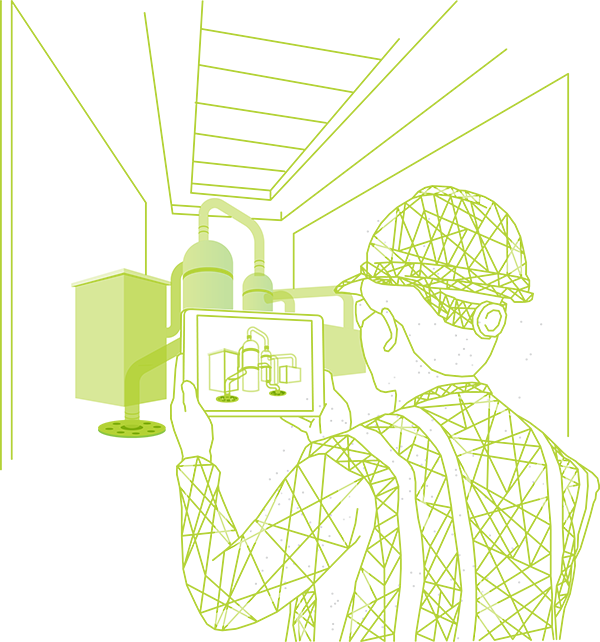
For example, a maintenance technician could potentially use AI glasses to identify equipment, retrieve relevant documentation, access a digital twin, receive contextual work instructions, and connect with a remote expert.
That does not mean Meta's current glasses automatically provide this complete industrial workflow. The workflow requires enterprise Industrial Digital Twin Software, connected data, AI models, security, and validated operational processes. The hardware is one layer.
Where does industrial XR fit?
The real opportunity emerges when XR connects to the data industrial companies already own. A typical industrial workflow can move from:
CAD/BIM → digital twin → immersive review → engineering decision → training → field execution → operational feedback
That creates a common spatial layer across the asset lifecycle.
For engineering teams, this can support CAD-to-XR design reviews and stakeholder collaboration. For learning teams, the same asset can support immersive training and scenario-based competency development. For operations and maintenance, the model can provide contextual visualization, work instructions, inspection support, and access to asset information.
Exxar Huddle CAD already brings CAD collaboration into the Meta Quest ecosystem, providing a practical example of how engineering data can move into immersive computing.
What could this mean for industrial companies?
The most important change may be the convergence of four technologies:
- Digital twins provide structured representations of physical assets.
- AI helps users interpret data and retrieve relevant information.
- XR provides spatial interaction with that information.
- Wearable interfaces make the experience more accessible in engineering and field environments.
Consider an oil refinery maintenance scenario. An engineer could review the equipment in an immersive environment before entering the plant. A technician could later access contextual instructions in the field. Inspection data could then be connected back to the asset record.
The objective is not to add XR to an existing process. It is to connect engineering information, operational knowledge, and physical execution.
Suggested reads: How CAD-to-XR supports the execution of Middle East giga-projects
What should industrial leaders prepare for?
Meta Connect 2026 reinforces an important enterprise technology trend: spatial computing is becoming less isolated from mainstream computing.
Industrial leaders should therefore evaluate XR around workflows rather than devices.
Key questions include:
- Which industrial processes depend on physical equipment access?
- Which engineering decisions can move earlier into immersive environments?
- Can existing CAD, BIM, PLM, ERP, or asset data feed spatial workflows?
- Where would hands-free AI create measurable value?
- Which training scenarios are expensive, hazardous, or difficult to reproduce?
- How will security, identity, device management, and enterprise data governance be handled?
- What business metric will determine success?
The last question matters most. XR investments should connect to measurable outcomes such as reduced training time, shorter design-review cycles, fewer engineering changes, faster inspections, lower travel requirements, improved knowledge transfer, or reduced maintenance downtime.
What does Meta Connect 2026 mean for the future of industrial XR?
Meta's latest announcements do not make every industrial XR use case immediately viable. Hardware availability, battery life, enterprise integration, cybersecurity, worker acceptance, industrial validation, and application maturity remain important considerations.
But the direction is clear.
VR is becoming lighter. AI is becoming more contextual. Digital representations are becoming more realistic. And wearable computing is moving closer to everyday workflows. For industrial enterprises, the opportunity is to connect these advances with the systems and processes that already run the business.
That is where industrial XR moves beyond visualization. It becomes an interface between engineering data, AI, digital twins, people, and physical assets. Exxar is building in that direction by connecting industrial 3D data and digital twins with immersive collaboration, training, inspection, and operational workflows.
Frequently asked questions
What is Meta Connect 2026?
Meta Connect 2026 is Meta's annual event focused on virtual reality, augmented reality, AI, wearable technology, and the broader spatial computing ecosystem. The 2026 announcements included new VR Glasses, AI-enabled glasses developments, and more realistic holographic avatars.
What are Meta VR Glasses?
Meta VR Glasses are a lightweight immersive computing device announced at $1,299. Bloomberg reports approximately 100 grams of headset weight, an external computing pack, around three hours of battery life, and approximately 2.5K resolution per eye.
What are Meta's holographic avatars?
Meta's holographic avatars are AI-generated digital representations designed for more realistic video communication. Meta's Muse Realtime Avatar model is used to approximate facial expressions, while newer VR glasses can support fuller-body representations.
What is the difference between VR glasses and AI glasses?
VR glasses are primarily designed for immersive spatial computing, including virtual environments, 3D applications, digital twins, and immersive collaboration. AI glasses focus on contextual assistance in the physical world through AI, cameras, sensors, audio, and displays.
How can Meta's XR ecosystem support industrial applications?
Potential applications include CAD and BIM visualization, design reviews, digital twins, VR training, remote collaboration, field assistance, inspection, and AI-powered work instructions. The actual enterprise workflow depends on the software, data integrations, security architecture, and operational validation built around the hardware.
Is Exxar available on Meta Quest?
Exxar Huddle CAD is available through Meta's Quest ecosystem and demonstrates how industrial CAD collaboration can be delivered through immersive computing. View Exxar Huddle CAD on Meta Quest.
What should enterprises measure when adopting industrial XR?
Organizations can evaluate XR through operational metrics such as design-review time, training time, competency, travel avoided, inspection cycle time, maintenance response, engineering rework, and knowledge-transfer effectiveness. The relevant metric depends on the workflow being transformed.