LNG Project Execution in the AI Era: What Gastech 2026 Leaders Need to Know

LNG projects are becoming larger, more complex, and more digitally connected. Yet one of the biggest project risks remains familiar: the gap between what is designed, what is constructed, and what ultimately reaches commissioning. That makes LNG project design validation more important than ever. At Gastech 2026 in Bangkok, Thailand, September 14–17, the conversation is moving beyond individual technologies. The event brings together natural gas and LNG, artificial intelligence (AI) and digitalization, low-carbon solutions, hydrogen, shipping and marine, supply chain, and emerging AI infrastructure themes. The practical question for LNG operators and engineering, procurement and construction (EPC) leaders is not simply whether AI can improve an engineering workflow. It is whether digital technologies can help connect engineering, construction, quality, commissioning, and workforce readiness into one more predictable project execution lifecycle.
What is LNG project design validation?
LNG project design validation is the process of checking whether an engineering design is technically sound, constructible, maintainable, safe, and operationally practical before problems reach the field. For a major LNG facility, that can include validating:
- Equipment access and maintenance clearances
- Piping and structural interfaces
- Constructability and installation sequences
- Operator access and safety considerations
- Inspection accessibility
- Engineering changes and their field implications
- Alignment between the digital model and physical construction
Traditional reviews often depend heavily on drawings, desktop models, meetings, and specialist knowledge. These methods remain essential. But they can make it difficult for multidisciplinary teams to understand how a complex facility will actually behave as a physical environment. That is where immersive visualization, digital twins, artificial intelligence, and augmented reality can add another layer of validation.
Why does design validation matter before LNG construction?
A design issue found during engineering is usually easier to address than the same issue discovered after fabrication or installation. Consider a simple example. A valve may be correctly positioned according to the engineering model. But once surrounding pipework, platforms, insulation, structural members, and access routes are considered, an operator may struggle to reach it.
- The engineering model may be technically correct.
- The installed environment may still be impractical.
- This is the engineering-to-field gap.
For LNG project leaders, its consequences can include:
- Rework
- Engineering changes
- Construction delays
- Additional inspection requirements
- Maintenance-access problems
- Safety concerns
- Commissioning disruptions
- Increased pressure on first-gas targets
Design validation therefore needs to move beyond asking, “Is the design correct?” It also needs to ask: “Can this facility actually be built, inspected, operated, and maintained as designed?”
What is Gastech 2026 signaling about LNG digitalization?
Gastech 2026 provides a useful view of where the industry is heading. Its official program brings together the Natural Gas & LNG sector with an expanded AI & digitalization technical program, alongside low-carbon solutions, hydrogen, shipping and marine, supply chain and procurement, and the co-located AixEnergy program. The AI & Digitalization program specifically examines how artificial intelligence is changing energy operations and emissions reduction. Its speaker and participants lineup includes technology and engineering leaders such as Toru Yoneyama, Technical Authority at Chiyoda Corporation, Praveen Bhaniramka (CEO Exxar), Manoj Kumar Bhardwaj (Vice President Operations, VizExperts) respectively. That matters because digitalization is increasingly being discussed in the context of actual project and operational outcomes rather than as a standalone IT initiative. For LNG executives, the opportunity is to connect those technologies to measurable execution problems.
How is AI changing LNG project execution?
AI can help project teams identify patterns, anomalies, and information across large volumes of engineering, inspection, construction, and operational data. But the highest-value applications are not necessarily the most futuristic. An LNG project can benefit when AI helps answer practical questions such as:
- Has the physical installation deviated from the engineering intent?
- Which inspection findings require attention?
- Where are recurring construction quality issues appearing?
- Which assets or areas require additional verification?
- Can field information be connected back to the project model?
This changes AI from a reporting layer into a potential execution intelligence layer. The same principle applies to digital twins.
How are digital twins improving LNG design validation?
A digital twin should not be treated simply as a 3D model. Its value comes from connecting the digital representation of an asset with relevant engineering, field, inspection, operational, or performance information. For LNG projects, this creates opportunities to maintain continuity from: Engineering → Design Review → Construction → Inspection → Commissioning → Operations That continuity is critical. A model used only during engineering creates limited value if the field team cannot use it during construction or inspection. A more useful approach is to make project information accessible at the point where decisions are being made. This is where immersive digital twins can become particularly valuable.
How can virtual reality improve LNG design reviews?
Virtual reality (VR) allows engineering and operations teams to review a facility at human scale before it exists physically. Instead of looking at a piping arrangement on a monitor, multidisciplinary teams can examine the environment spatially. They can evaluate:
- Equipment accessibility
- Operator movement
- Maintenance envelopes
- Safety access
- Piping congestion
- Visibility
- Constructability
- Spatial relationships between disciplines
Exxar VR Design Reviews extends this concept by turning computer-aided design (CAD) and building information modeling (BIM) data into an immersive review environment. The objective is not to replace engineering software. It is to give project stakeholders another way to validate engineering intent before that intent becomes expensive physical work.
How can augmented reality reduce LNG construction deviations?
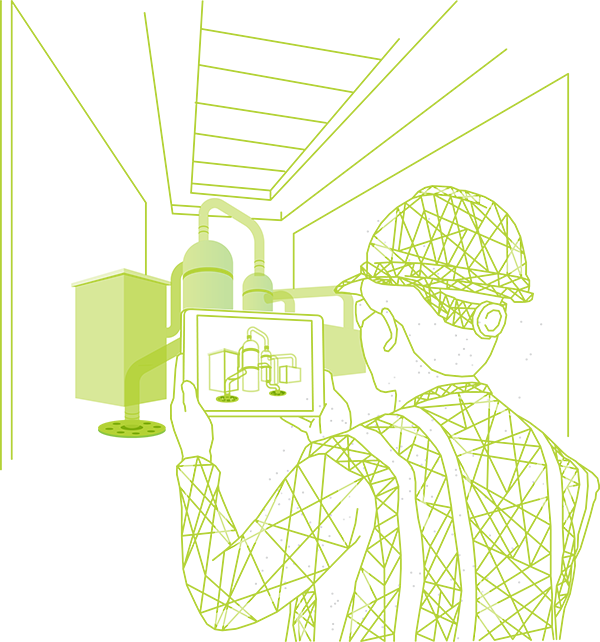
Once construction begins, the problem changes. The question is no longer only whether the design works. It becomes: “Is the physical asset being built as designed?” Augmented reality (AR) can help connect digital engineering information with the physical work environment. Field teams can use digital information in context to support installation verification, identify deviations, and make engineering information easier to interpret at the workface. This is particularly relevant for large LNG facilities where changes in piping, structures, equipment, and access conditions can create downstream consequences. Our detailed guide on AR in LNG construction and reducing field deviations explores how this approach can help reduce rework and protect critical project milestones.
How can AI visual inspection improve LNG construction quality?
Quality assurance is another point where the digital and physical worlds need to meet. Manual inspection remains essential, particularly for safety-critical infrastructure. But inspection programs can generate large volumes of images, observations, records, and asset information. AI-powered visual inspection can help teams analyze visual information more consistently and identify potential anomalies for human review. Combined with digital twin information, inspection data can become more useful than a standalone collection of photographs and reports. It can provide a stronger connection between: What was designed → What was installed → What was inspected Our related article, How Digital Twins and AI Inspection Are Improving LNG Construction Quality, explores this connection in greater detail.
Why does VR training matter for LNG operational readiness?
Project execution does not end when construction is complete. A technically successful LNG facility still needs people who understand the equipment, procedures, hazards, and operating environment. VR training provides an opportunity to rehearse procedures in an immersive environment before personnel encounter the physical asset. This can support:
- Safety training
- Equipment familiarization
- Standard operating procedure (SOP) training
- Emergency response preparation
- Maintenance scenarios
- Operator competency development
For LNG operators, the strategic value is continuity. The same digital asset used to review design can potentially support construction visualization, inspection workflows, and workforce preparation. That is a more powerful proposition than deploying isolated digital tools.
What should LNG leaders evaluate before adopting these technologies?
Technology selection should start with project risk, not technology. LNG executives should ask five questions:
- Where are our most expensive engineering-to-field disconnects?
- Which design decisions are hardest to validate before construction?
- Where does field verification depend too heavily on manual processes?
- Which quality and inspection workflows generate the most actionable data?
- Can our digital information remain useful from engineering through operations?
The strongest business case will usually come from a specific, measurable problem rather than an organization-wide technology rollout. A high-risk design review, construction verification workflow, inspection process, or workforce competency requirement can provide a practical starting point.
What does Gastech 2026 mean for the future of LNG project execution?
Gastech 2026 reflects a broader shift in the energy industry. AI, digital twins, immersive technologies, field intelligence, and automation are increasingly converging around one objective: making complex energy projects more predictable to design, build, inspect, commission, and operate. For LNG project leaders, the opportunity is not to digitize every activity simply because the technology exists. It is to close the gaps that create the greatest commercial and operational risk. That means connecting engineering intent with physical execution. Exxar approaches this through a connected industrial technology stack covering VR design reviews, construction AI with AR, AI visual inspection, and VR training. The strategic value is in connecting these capabilities across the asset lifecycle rather than treating them as isolated applications. For LNG operators and EPC leaders evaluating their next project, that raises a more useful question than “Where can we use AI?” Where is the gap between our digital project and our physical project costing us the most? That is where the next generation of LNG project execution can begin.
Meet Exxar at Gastech 2026
If you are attending Gastech 2026 in Bangkok, connect with the Exxar team to discuss how VR design reviews, construction AI with augmented reality, AI visual inspection, and VR training can help close the gap between engineering, construction, quality, and operational readiness.