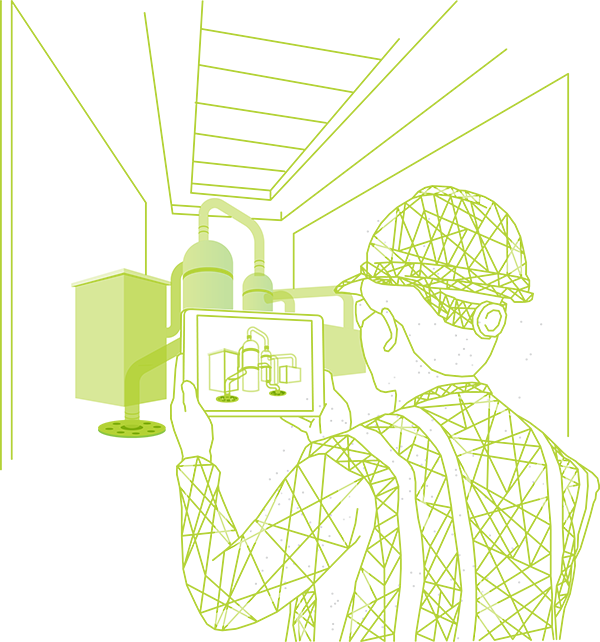
Digital Twins for Brownfield Energy Projects: Validate Modifications Before Shutdowns

Brownfield energy projects rarely fail because engineers cannot design the proposed change. They become difficult when the design meets an existing asset with incomplete records, previous modifications, constrained access, aging equipment, live operations, and a limited shutdown window.
This is where digital twins for brownfield energy projects can create a measurable business advantage.
A brownfield digital twin gives engineering, project, maintenance, and operations teams a shared environment to test physical changes before committing capital, contractors, equipment, and production time. Instead of asking only what the proposed modification looks like, teams can assess whether it can be installed, accessed, maintained, inspected, commissioned, and operated within the constraints of the existing asset.
Research is already moving in this direction. A study proposed a nine-step roadmap for semi-automatic generation of digital twins for brownfield process plants from legacy engineering and asset information. The strategic question for energy leaders is therefore not:
“How do we digitize the plant?”
It is:
“Which upcoming physical decision is expensive to get wrong, and what can we validate before execution?”
What is a brownfield digital twin in business terms?
A brownfield digital twin is a digital representation of an existing asset that brings together relevant engineering, spatial, equipment, and operational information to support decisions about that asset. It does not have to begin as a fully connected real-time replica.
For many brownfield projects, the highest-value starting point is a decision-ready model built from available information such as:
- Computer-aided design (CAD) and building information modeling (BIM) data
- Piping and instrumentation diagrams (P&IDs)
- Equipment specifications and engineering documents
- Laser scans and LiDAR point clouds
- As-built information
- Existing 3D models
- Maintenance and inspection information
- Proposed modification designs
The objective is not simply to recreate the facility digitally. But to reduce uncertainty before physical execution.
Why are brownfield modifications harder to execute than greenfield projects?
Greenfield projects provide an opportunity to design the environment around the new asset. Brownfield projects must work within an environment that already exists. That difference changes the economics of decision-making.
| Greenfield project | Brownfield project |
|---|---|
| Asset configuration is being created | Existing configuration must be understood |
| Engineering data is generated with the project | Information may be distributed across legacy systems |
| Physical constraints can be designed early | Existing equipment, piping and structures constrain change |
| Installation sequencing can be planned from the beginning | Work must fit around operating assets and shutdown windows |
| Design changes occur before physical execution | Changes may affect live operations, access and production |
Consider a hypothetical refinery equipment replacement. The new equipment may fit within the engineering model. That does not necessarily mean the replacement can be executed efficiently. The project team still needs to know:
- Can the equipment reach the installation location?
- Is there sufficient lifting and removal clearance?
- Does new piping clash with existing infrastructure?
- Can technicians access valves, instruments and maintenance points?
- Will temporary structures interfere with adjacent equipment?
- Can the modification be completed within the available shutdown window?
- Does the proposed sequence create conflicts between contractors?
A digital twin creates a spatial decision environment where these questions can be tested before the site becomes the test environment.
Where does the business value come from?
The strongest business case for a brownfield digital twin is not visualization. It is avoided uncertainty. A useful executive framework is:
Data confidence → spatial confidence → modification confidence → execution confidence
Each layer reduces a different category of project risk.
1. Improve engineering confidence
Legacy drawings and models can be compared against available as-built information. This helps teams identify discrepancies before detailed planning progresses too far.
2. Validate physical changes
New equipment, piping, structural elements and access requirements can be reviewed against the existing environment.
3. Reduce field surprises
Spatial conflicts that are difficult to identify in two-dimensional drawings can become visible before contractors arrive on site.
4. Protect shutdown windows
A shorter shutdown is not automatically better. The critical issue is whether the planned work can be executed within the available operating window.
Digital validation can help project teams identify sequencing, access and constructability constraints earlier.
5. Reuse engineering intelligence
The same asset context can support design review, construction planning, inspection, maintenance, training and operational readiness instead of becoming another project-specific model that loses value after handover.
What does research say about brownfield digital twins?
Brownfield digitalization has a fundamental data problem Existing plants rarely begin with a clean, unified digital information environment. Engineering records can span legacy CAD files, P&IDs, PDFs, spreadsheets, scans, maintenance systems and undocumented physical changes.
A 2022 ScienceDirect study, “Roadmap to semi-automatic generation of digital twins for brownfield process plants,” specifically addressed this challenge and proposed a structured methodology for generating digital twins from brownfield source information. That research is important because it shifts the discussion away from creating a perfect digital model manually. The practical question becomes:
“How can existing engineering information be converted into a usable digital representation efficiently enough to support real project decisions?”
Recent industry work from organizations including AVEVA and Dassault Systèmes similarly positions brownfield digital twins around connecting existing asset information with engineering, modification, and operational decisions. This is particularly relevant for energy infrastructure where replacement of an entire facility is rarely the first economic option.
How can digital twins reduce shutdown and modification risk?
The highest-value use cases are usually the decisions with three characteristics:
High consequence + high spatial complexity + limited execution time
These include:
- Major equipment replacement
- Plant debottlenecking
- Brownfield expansions
- Piping modifications
- Electrical and instrumentation upgrades
- Tie-ins
- Structural modifications
- Maintenance access changes
- Shutdown and turnaround planning
- New equipment installation
- Decarbonization and process retrofit projects
A digital twin can support a sequence such as:
Existing asset → proposed modification → spatial validation → access and constructability review → execution planning → field execution
The important distinction is that the model becomes part of the decision process, rather than simply a visualization deliverable.
Does a brownfield digital twin need real-time data?
No. Real-time data can increase the value of a digital twin, but it is not a prerequisite for every brownfield use case. For a modification project, engineering and spatial accuracy may matter more than continuous sensor feeds. A practical maturity path can therefore be:
Engineering data → spatial model → modification validation → operational data → AI and analytics
This matters because waiting for complete Internet of Things (IoT) connectivity, sensor coverage, or a fully integrated enterprise data architecture can delay a project that already has an immediate engineering problem to solve.
Start with the decision. Then build the level of digital fidelity required to make that decision with greater confidence.
How does XR make brownfield decision-making more useful?
A desktop model can show whether components intersect. Extended reality (XR) can help teams understand what that intersection means in the physical environment. Immersive review allows engineering and operations teams to evaluate:
- Human access
- Equipment visibility
- Maintenance reach
- Spatial constraints
- Work areas
- Installation sequences
- Emergency access
- Operator perspective
This becomes particularly valuable when people from different disciplines need to review the same proposed change. Instead of interpreting separate drawings, each stakeholder can review the proposed modification in the context of the existing asset.
Exxar's VR design review capabilities support this type of immersive engineering review, using industrial 3D data as the foundation for spatial decision-making.
Where can brownfield digital twins create value across the energy industry?
The business case extends beyond a single plant type.
Oil and gas
Brownfield digital twins can support modification planning, equipment replacement, tie-ins, maintenance access and operational changes across complex upstream, midstream and downstream assets.
Refineries
Refinery modifications often involve dense equipment, piping, structures and operating constraints. Digital validation can help teams evaluate proposed changes before shutdown execution. Exxar's oil refinery solutions address industrial XR and digital twin use cases across refinery environments.
LNG
LNG facilities combine complex process systems with demanding safety, access and maintenance requirements. A spatially accurate asset context can support modification planning and lifecycle engineering. Explore LNG solutions for applications across the asset lifecycle.
Thermal power
Aging generation assets face continued pressure to improve reliability, maintainability and operating performance while extending asset life. Digital twin workflows can help teams evaluate equipment and plant changes before field execution. Exxar applies these approaches to thermal power plant training and industrial asset environments.
Process plants
Process facilities often combine legacy engineering information with continuous modifications over decades. A brownfield digital twin can provide a more usable spatial and engineering context for process plant applications.
Solar and other energy assets
Brownfield thinking also applies beyond conventional hydrocarbons. Existing generation and energy infrastructure can require equipment replacement, expansion, inspection and maintenance planning. The broader opportunity is to create a reusable digital context across energy plant applications rather than treating every modification as an isolated engineering exercise.
How should executives evaluate the ROI of a brownfield digital twin?
The right question is not simply:
“What does the software cost?”
It is:
“What physical decisions can this digital environment help us make earlier and with greater confidence?”
A business case should evaluate potential impact across five areas:
- Engineering effort
Can teams identify design conflicts before detailed engineering or field work? - Rework
Can avoidable fabrication, installation or modification errors be identified earlier? - Shutdown exposure
Can execution risks be reduced before a limited outage window begins? - Site coordination
Can engineering, contractors, maintenance and operations teams review the same physical context? - Asset reuse
Can the resulting digital environment support inspection, training, maintenance and future modifications?
This approach avoids promising a universal percentage reduction in project cost. The actual ROI depends on the asset, project scope, data quality, shutdown economics and decisions being supported.
What should energy executives ask before investing?
Before launching a large digital twin program, leadership should ask:
Which upcoming decision has the highest cost of being wrong?
Then ask:
- What engineering and asset information already exists?
- How accurately does it represent the current physical asset?
- Which modifications create the greatest spatial uncertainty?
- Which decisions must be made before the next shutdown?
- What level of model fidelity is actually required?
- Can the model be reused beyond the immediate project?
- Can engineering, operations and maintenance teams work from the same context?
- How will success be measured in business terms?
This creates a much stronger starting point than attempting to digitize every asset simultaneously.
The strategic opportunity: turn existing asset data into decision infrastructure
Brownfield energy projects will continue to require physical change. Equipment will be replaced. Plants will be expanded. Processes will be modified. Energy infrastructure will be upgraded. Existing assets will also need to operate safely while those changes happen around them.
The competitive advantage will not come simply from having a 3D model of the facility. It will come from using engineering and asset information to make better physical decisions before execution. That is the strategic role of digital twins for brownfield energy projects.
The strongest implementation path is therefore not: Model everything. Connect everything. Then find a use case. It is:
Identify the high-consequence decision. Build the required digital context. Validate the change. Execute with greater confidence. Reuse the asset intelligence across the lifecycle.
For energy companies preparing for major modifications, shutdowns, expansions and capital projects, that turns the digital twin from a visualization asset into a practical decision-risk layer for the physical plant.
Exxar brings engineering data, industrial digital twins, artificial intelligence and extended reality together to support design, validation, training, inspection and operations across complex industrial assets.
Explore AI + XR Industrial Digital Twins for brownfield energy projects and lifecycle execution.