AI Data Center Construction: How XR Improves MEP Coordination and Reduces Rework

AI data center construction is increasing the complexity of mechanical, electrical, and plumbing (MEP) coordination. High-density server racks, advanced cooling infrastructure, electrical distribution systems, and extensive cable networks must operate within tightly constrained spaces. A coordination issue that goes unnoticed during design can become an installation obstruction, costly field change, or commissioning delay.
Building Information Modeling (BIM) and automated clash detection help identify geometric conflicts before construction. However, a clash-free model does not necessarily confirm that equipment is accessible, installations are practical or maintenance routes are clear.
Extended Reality (XR), including Virtual Reality (VR), Augmented Reality (AR) and Mixed Reality (MR), adds an immersive review layer to data center construction. It helps engineering and construction teams examine coordinated 3D models at full scale, evaluate spatial constraints and communicate potential issues before installation.
Why AI Data Center Construction Requires Better MEP Coordination
The expansion of AI infrastructure is increasing demand for data center capacity, power and cooling. The International Energy Agency (IEA) estimates that global data center electricity consumption reached approximately 415 TWh in 2024. It projects consumption could approach 945 TWh by 2030. The United States Department of Energy report estimates that data centers accounted for approximately 4.4% of national electricity consumption in 2023. This share could rise to 6.7–12% by 2028.
As data center projects scale, coordinating their infrastructure becomes increasingly important. Depending on the facility design, engineering teams may need to coordinate:
- Electrical systems: Switchgear, transformers, UPS equipment, busways, power distribution units and cable containment.
- Cooling systems: Chilled-water pipework, cooling distribution units (CDUs), pumps, manifolds and liquid-cooling infrastructure.
- Building systems: Structural supports, ventilation, fire protection and overhead services.
- Operational requirements: Equipment clearances, technician access, maintenance routes and replacement paths.
For example, an AI data center's cooling pipework may compete for overhead space with electrical busways, cable trays and ventilation systems. Even without a direct geometric clash, the arrangement could restrict equipment access or complicate future maintenance.
This is why data center MEP coordination must consider more than whether individual systems fit within the building model.
How XR Improves Data Center MEP Coordination
XR complements conventional BIM coordination by helping stakeholders understand engineering models in an immersive, human-scale environment.
1. Review complex MEP installations at full scale
Desktop BIM reviews provide detailed model navigation and geometric analysis. However, understanding the physical scale of congested installations can be difficult when viewing complex systems on a screen. With VR design reviews, engineers and contractors can enter a 1:1 scale virtual representation of a data center before construction begins.
For example, a multidisciplinary team can examine how chilled-water pipes, overhead cable trays, structural supports and ventilation ducts interact within a mechanical plant room. This helps stakeholders identify potential spatial constraints, examine alternative viewpoints and assess whether an installation appears practical.
XR does not replace automated clash detection. Instead, it adds human-scale visualization and engineering judgement to the coordination process.
2. Validate equipment access and maintenance clearances
Equipment placement is only one consideration in data center design. Technicians must also be able to inspect, service, and replace equipment safely. An immersive design review allows teams to evaluate:
- Access to valves, pumps, filters, and electrical panels.
- Clearance around switchgear, server racks, and cooling equipment.
- Technician movement through congested service areas.
- Equipment removal and replacement routes.
- Obstructions caused by overhead MEP installations.
Consider a cooling distribution unit positioned beside multiple pipework connections. Its placement may satisfy the design layout, but adjacent installations could restrict access to service connections.
Reviewing this arrangement at full scale helps engineering and facility teams raise accessibility concerns before installation.
3. Improve collaboration across engineering disciplines
Data center construction involves architects, structural engineers, MEP consultants, contractors, XR solutions for MEP trades and HVAC, and commissioning teams. Each discipline must understand how its design decisions affect other systems.
Multi-user VR collaboration allows stakeholders to review the same digital environment, discuss spatial constraints, and evaluate proposed design changes together.
For example, electrical and mechanical teams can examine a congested service area and discuss alternative routing before the approved design is released for installation. This can improve design communication and support earlier decisions, particularly across geographically distributed project teams. Actual resolution times still depend on engineering approvals and project coordination processes.
4. Connect immersive reviews with BIM issue management
Identifying a potential coordination issue is only useful when the responsible team can investigate and resolve it. Some XR and BIM coordination workflows support annotations, saved viewpoints, issue creation, and integration with project collaboration systems. Available capabilities depend on the selected software and integration.
For example, a reviewer could flag a cable tray that appears to obstruct access to a cooling component. The responsible engineer can investigate the location in the BIM authoring environment, such as Autodesk Revit, and coordinate an approved design change.
How AR Supports Data Center Construction Verification
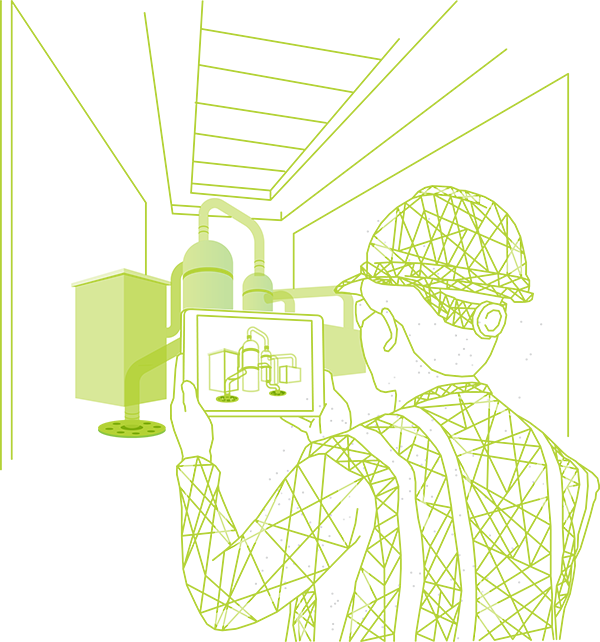
VR supports design and preconstruction reviews. AR and MR can extend model-based workflows into the physical construction environment. Where an approved 3D model and reliable registration workflow are available, site teams can compare design information with installed conditions.
Potential applications include:
- Reviewing equipment placement against approved design intent.
- Examining pipework and cable containment routes.
- Identifying visible installation deviations for further inspection.
- Communicating construction discrepancies with engineering teams.
For example, a site team could use AR to visualize an approved service route in its physical location. If the installed arrangement differs, the team can flag the condition for engineering review before subsequent work proceeds. AR is an additional visual reference, not a replacement for surveying, dimensional inspection, installation tolerances, or formal quality assurance.
BIM Coordination vs. XR Design Reviews
| BIM coordination | XR design reviews |
|---|---|
| Examines digital building models | Presents models in immersive environments |
| Identifies geometric conflicts through coordination tools | Helps stakeholders understand spatial relationships at human scale |
| Supports model-based design coordination | Supports accessibility and constructability reviews |
| Primarily model and screen based | Supports collaborative, immersive reviews |
The two approaches work best together. BIM establishes the coordinated engineering model, while XR helps teams evaluate its practical implications.
What to Look for in Data Center VR and AR Solutions
Before selecting an XR platform, US data center developers, engineering consultants, and contractors should evaluate:
- CAD and BIM compatibility: Support for the project's engineering models and file formats.
- Full-scale visualization: Accurate 1:1 representation of complex installations.
- Collaboration: Multi-user reviews across engineering and construction teams.
- Issue communication: Annotations, viewpoints, and supported project-management integrations.
- Field verification: Suitable AR workflows for comparing approved models with site conditions.
- Enterprise deployment: Security, access controls, and compatibility with project IT requirements.
The solution should complement existing BIM authoring, coordination, and quality processes and align with applicable project requirements and standards, including the National Electrical Code and relevant NFPA guidance.
How Exxar Supports XR-Based Data Center Design Reviews
Exxar VR Design Reviews transform compatible 3D CAD and BIM models into immersive environments for collaborative engineering reviews.
Teams can examine designs at full scale, understand spatial relationships and evaluate equipment placement and accessibility before construction progresses.
For data center projects, this approach can support reviews of electrical rooms, mechanical plant areas, cooling infrastructure and congested MEP installations.
Exxar's BIM-to-VR workflows and Navisworks VR capabilities support immersive reviews within model-based engineering workflows. Its Construction AI AR solutions address augmented reality applications in construction.
By bringing engineering models into immersive environments, Exxar helps project teams communicate design intent, evaluate potential coordination issues and make better-informed decisions before installation.
Planning an AI data center project? Explore Exxar's VR design review capabilities and request a demonstration.
Frequently Asked Questions
How does XR help prevent MEP rework in data center construction?
XR enables teams to review coordinated MEP models at full scale, helping identify potential spatial, access and constructability issues before installation. It complements BIM clash detection and conventional engineering reviews.
What is the difference between BIM coordination and VR design reviews?
BIM coordination uses digital models and software tools to coordinate building systems and identify geometric conflicts. VR design reviews place those models in an immersive environment, helping stakeholders assess spatial relationships and equipment accessibility.
Can VR reduce data center construction rework?
VR can help identify potential design and accessibility issues before construction. Resolving issues earlier may reduce avoidable field changes, although actual savings depend on model quality, review processes and project execution.
How is AR used in data center construction?
AR can overlay approved 3D model information onto physical construction environments. Teams can use suitable workflows to review equipment placement, installation routes and potential differences between design intent and site conditions.
Does XR replace BIM clash detection software?
No. XR complements BIM coordination and automated clash detection. Clash detection identifies geometric conflicts, while immersive reviews help teams evaluate spatial context, accessibility and practical installation considerations.